Spazi di lavoro
Workspaces are essentially predefined window layouts. Each Workspace consists of a set of Areas containing Editors, and is geared towards a specific task such as modeling, animating, or scripting. You’ll typically switch between multiple Workspaces while working on a project.

Gli spazi di lavoro si trovano nella barra superiore.
Controlli
- Schede
Click on the tabs to switch between workspaces. Double-click a tab to rename the workspace.
- Add Workspace
Adds a new workspace from a predefined template (e.g. Modeling, Sculpting, Compositing).
Context Menu RMB
- Duplica
Makes a copy of the selected workspace, including its screen layout and editors.
- Cancella
Deletes the selected workspace. If it is the last workspace, it cannot be removed.
- Reorder to Front/Back
Moves the workspace tab to the first (front) or last (back) position in the tab list.
- Previous Workspace Ctrl-PageUp
Activates the workspace immediately to the left of the current one.
- Next Workspace Ctrl-PageDown
Activates the workspace immediately to the right of the current one.
- Delete Other Workspaces
Removes all workspaces except the one that was right-clicked on.
Spazi di lavoro predefiniti
Blender’s default startup shows the «Layout» workspace in the main area. This workspace is a general workspace to preview your scene and contains the following Editors:
3D Viewport on top left.
Outliner on top right.
Properties on bottom right.
Timeline on bottom left.
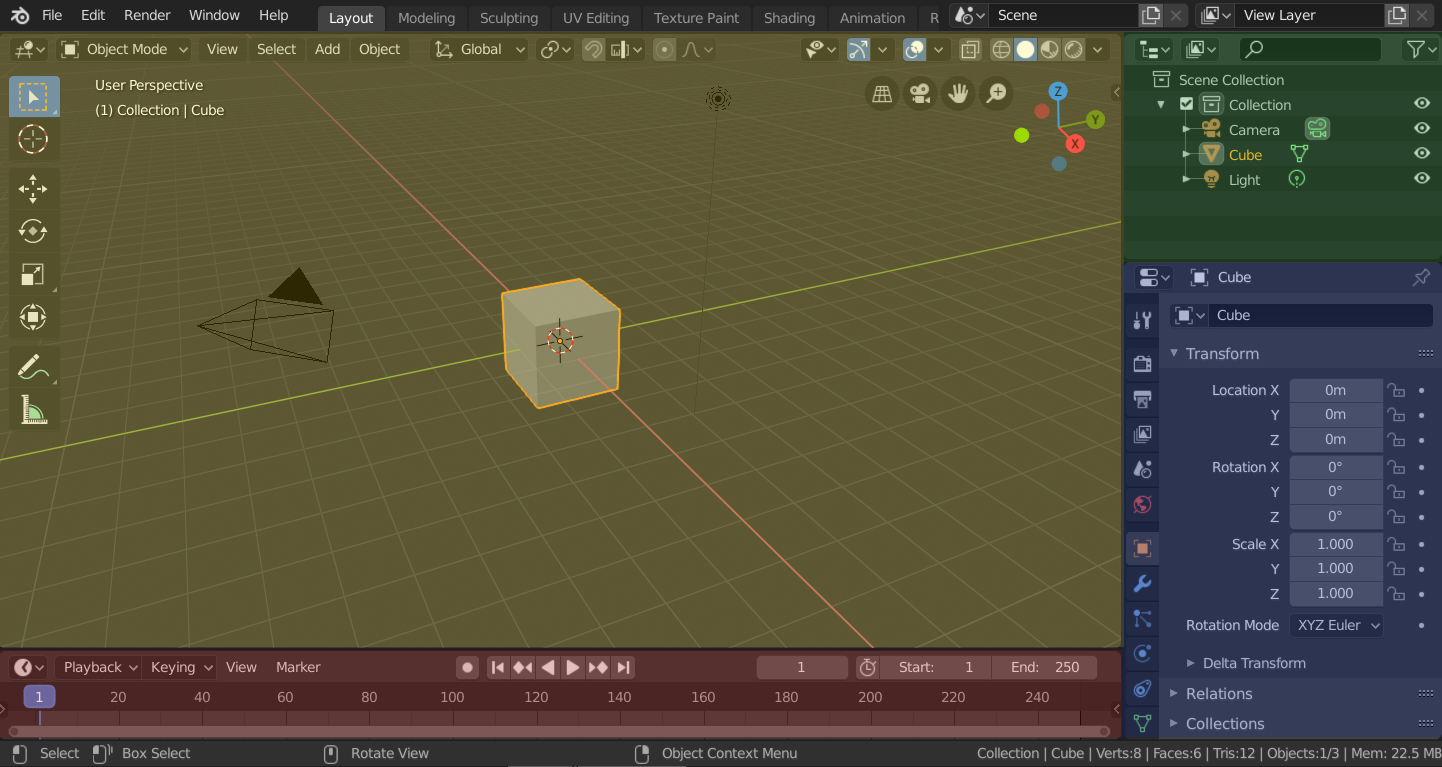
Blender’s “Layout” Workspace with four editors.
3D Viewport (yellow), Outliner (green), Properties (blue) and Timeline (red).
Blender ha anche altre aree di lavoro aggiunte per impostazione predefinita:
- Modellazione:
Per la modifica della geometria mediante strumenti di modellazione.
- Sculpting:
Per la modifica delle mesh mediante strumenti di scultura.
- Modifica UV:
For mapping of image texture coordinates to 3D surfaces.
- Pittura Texture:
For coloring image textures in the 3D Viewport.
- Ombreggiatura:
For specifying material properties for rendering.
- Animazione:
For making properties of objects dependent on time.
- Rendering:
Per visualizzare e analizzare i risultati di rendering.
- Composizione:
For combining and post-processing of images and rendering information.
- Geometry Nodes:
For procedural modeling using Geometry Nodes.
- Scripting:
For interacting with Blender’s Python API and writing scripts.
Spazi di lavoro aggiuntivi
Blender has a couple additional Workspaces to choose from when adding a new Workspace:
Animazione 2D
- Animazione 2D:
Spazio di lavoro generale per lavorare con Grease Pencil.
- Canvas intero 2D:
Simile a «Animazione 2D» ma contiene una tela più grande.
VFX
- Mascheramento:
For creating 2D masks for compositing or video editing.
- Tracciamento del Movimento:
For calculating camera motion and stabilizing video footage.
Video Editing
- Video Editing:
For sequencing together media into one video.
Salva e sostituisci
The workspaces are saved in the blend-file. When you open a file, enabling Load UI in the File Browser indicates that Blender should use the file’s screen layout rather than the current one.
Un set personalizzato di spazi di lavoro può essere salvato come parte di Defaults.
Workspace Settings
Riferimento
- Editor:
- Pannello:
- Pin Scene
When enabled, the current workspace will remember the currently selected scene. Then, whenever you activate the workspace, it’ll automatically switch back to that scene.
- Modalità
Switch to this Mode when activating the workspace.
- Sequencer Scene
The scene containing the edit that is used by the video sequence editor. See Sequencer Scene.
- Sync Scene Time
Sync the active scene and time based on the current scene strip in the video sequence editor. See Sequencer Scene.
- Filter Add-ons
Determines which add-ons are enabled in the active workspace. When unchecked, the global add-ons will be used. When checked, you can enable individual add-ons in the list below.