Nút tỷ lệ (Scale Node)
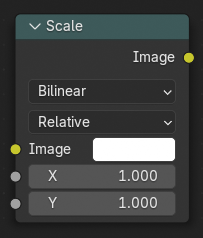
This node scales the size of an image.
Đầu Vào (Inputs)
- Hình Ảnh (Image)
Đầu vào màu tiêu chuẩn.
- Phân Khoảng Cách/Trống/Không Gian (Space)
Không gian tọa độ để đổi tỷ lệ tương đối với.
- Tương Đối (Relative):
Percentage values relative to the dimensions of the image input.
- Tuyệt Đối (Absolute):
Size of an image by using absolute pixel values.
- Kích Thước Cảnh (Scene Size):
Sizes an image to the size of the final render resolution for the scene. For example, rendering a scene at the standard 1080p resolution but setting the render percentage at 50%, will produce a 1080p image with the scene scaled down 50% and leaving the rest of the image as alpha.
- Kích Thước Kết Xuất (Render Size):
Image dimensions set in the Render panel.
- Frame Type Render Size
How the image fits in the camera frame.
- Kéo Giãn (Stretch):
Distorts the image so that it fits into the render size.
- Khít Vừa (Fit):
Scales the image until the bigger axis "fits" into the render size.
- Cắt Xén (Crop):
Cuts the image so that it is the same aspect ratio as the render size.
- X, Y
Scale in the axis directions, only available if Space is set to Relative or Absolute.
Lấy Mẫu Vật (Sampling)
- Interpolation (Nội Suy)
Determines how pixel values are interpolated when scaling or transforming images.
- Gần Nhất (Nearest):
Uses the value of the closest pixel with no smoothing. This is the fastest method and is well-suited for pixel art or low-resolution images where sharp, blocky edges are desirable. In animations, motion appears in single-pixel steps, which can cause visible jittering.
- Song Tuyến Tính (Bilinear):
Averages the values of surrounding pixels to create a smoother result than Nearest. Provides a good balance between performance and visual quality.
- Song Lập Phương (Bicubic):
Computes a weighted average of a larger neighborhood of pixels for even smoother results. Ideal for photographic images or gradients where preserving fine detail is important.
- Dị Hướng [Anisotropic]:
Adjusts interpolation based on the direction and scale of the transformation. Helps reduce blurring or aliasing when scaling at steep angles or uneven resolutions, especially useful in textures viewed at oblique angles or in detailed 3D projections.
- Extension X/Y
The extension mode applied to the X axis.
- Cắt Xén/Đoạn Phim (Clip):
Areas outside of the image are filled with transparency.
- Nới/Mở Rộng (Extend):
Areas outside of the image are filled with the closest boundary pixel in the image.
- Lặp Lại (Repeat):
Areas outside of the image are filled with repetitions of the image.
Đầu Ra (Outputs)
- Hình Ảnh (Image)
Đầu ra màu sắc chuẩn.
Một Số Ví Dụ (Examples)
For instance X: 0.5 and Y: 0.5 would produce an image which width and height would be half of what they used to be.
Use this node to match image sizes. Most nodes produce an image that is the same size as the image input into their top image socket. To uniformly combine two images of different size, the second image has to be scaled up to match the resolution of the first.