Nhóm Nút (Node Groups)
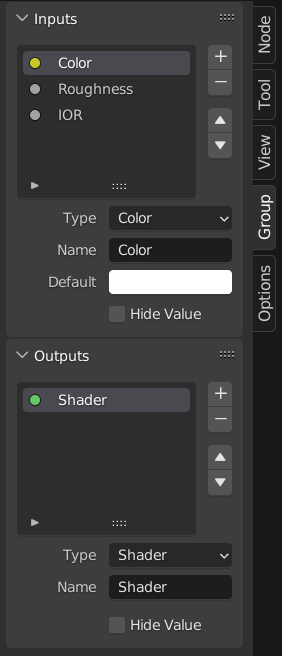
Ví dụ về nhóm nút.
Grouping nodes can simplify a node tree by hiding complexity and reusing common functionality. A node group is visually identified by its green title bar.
Conceptually, node groups allow you to treat a set of nodes as a single unit. They are similar to functions in programming: reusable, composable, and parametrizable.
For example, suppose you create a "Wood" material and want to use it in multiple colors. You could duplicate the entire node setup for each color, but maintaining those duplicates would be tedious if you later decide to change the wood grain detail. Instead, you can move the nodes that generate the wood pattern into a node group. Each material can then reuse this group and supply a custom color as input. Any updates to the grain detail need to be made only once—inside the node group.
Node groups can be nested; that is, a group can contain other groups.
Ghi chú
Recursive node groups are prohibited to avoid infinite recursion. A group cannot contain itself, directly or indirectly.
Mẹo
Like other data-blocks, node groups with names that start with . are hidden
from menus and lists and can only be accessed via search.
This is useful for node asset authors who want to hide internal utility groups from end users.
Group Input and Group Output nodes are used to represent data flowing into and out of the group.
The Group Input node provides access to the group's input sockets from within the node group. These sockets act as parameters that control the behavior of the group from the outside. You can connect them to internal nodes to drive values such as factors, colors, or geometry inputs.
Ghi chú
Input values that do not affect the output will be grayed out.
The Group Output node defines the data that is passed out of the node group. Only sockets connected to this node will be available as outputs on the group itself.
Quan trọng
Avoid using nodes output nodes such as Material Output inside node groups. These should be used on the top level node tree to improve re-usability of node groups.
Use Group Output to pass data out of a node group.
Cách Dùng [Usage]
Managing Inputs/Outputs
You can add, remove, and reorder input and output sockets in the Group panel in the Sidebar. New sockets can also be created directly by dragging a link to or from the hollow socket on the Group Input or Group Output node to another socket in the node editor.
Tái Sử Dụng các Nhóm Nút (Reusing Node Groups)
Tham Chiếu [Reference]
- Trình Đơn [Menu]:
- Tổ Hợp Phím Tắt [Shortcut]:
Shift-A
Các nhóm nút hiện có có thể được hoàn lại sau khi chúng được định nghĩa lần đầu tiên, cho dù là trong cùng một cấu trúc cây nút hoặc ở một cây khác. Chúng ta cũng có thể nhập khẩu các nhóm nút từ một tập tin blend khác bằng cách sử dụng .
Mẹo
When appending node groups from another blend-file, Blender does not distinguish between types such as material or compositing groups. To avoid confusion, it is recommended to adopt a naming convention, like using prefixes (Mat_, Comp_, Geo_, etc.), to indicate the group's context.
Tính Chất (Properties)
Nhóm (Group)
Tham Chiếu [Reference]
- Panel (Bảng):
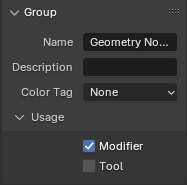
The "Nhóm" bảng.
This panel contains properties that relate the group node such as it's name and look.
- Tên [Name]
The tên của nút as displayed trong giao diện-nút-phần-đầu đề (interface-nodes-parts-title).
- Miêu Tả [Description]
The message displayed when hovering over the Đầu Đề (Title) or in add menus.
- Nhãn Màu (Color Tag)
Color tag of the node group which influences the header color.
- Chiều Rộng Nút [Node Width]
The chiều rộng cho/đối với newly created các nút nhóm.
- (Đặt Mặc Định Chiều Rộng Nút [Set Default Node Width])
Set the width based on the parent group node in the current context
- Show Manage Panel Geometry Nodes
Enables displaying the Quản Lý [Manage] panel in Geometry Nodes modifiers when creating a modifier from a node group asset.
Cách Dùng [Usage] Các Nút Hình Học (Geometry Nodes)
This bảng được duy hữu hình trong Trình Biên Soạn Nút Hình Học (Geometry Node Editor).
- Bộ Điều Chỉnh
The node group is intended for use with the Bộ Điều Chỉnh các Nút Hình Học (Geometry Nodes Modifier).
- Công Cụ (Tool)
The node group is intended to be used as a tool.
The data-block menu in the header of the Geometry Node Editor only lists the node groups whose Usage matches the current Node Tree Sub-Type.
Mẹo
If you accidentally disable both Usages, the node group will not be accessible through the data-block menu anymore. To make it accessible again, you can add it as a node to a different node group (), select that node, and press Tab to enter it. From there, you can enable one of the Usages again.
Nhóm Ổ Cắm [Group Sockets]
Tham Chiếu [Reference]
- Panel (Bảng):
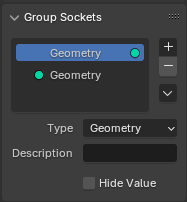
The "Nhóm Ổ Cắm" bảng.
This panel is used to add, remove, reorder, and edit the user interface elements of a node group. It defines how sockets appear on the group node and organizes them for clarity and usability.
Available item types include:
Inputs: Define input sockets for the node group.
Outputs: Define output sockets for the node group.
- Panels:
Group and organize related sockets together. Useful for structuring complex node setups. Panels always appear at the bottom of the node interface. They can be nested by dragging one panel on top of another in the interface item list.
- Panel Toggle:
Adds a boolean checkbox to a panel's header, allowing control over its contents. This option is only available when a panel is selected in the interface item list.
Panel toggles have their own options under the Panel Toggle subpanel. Note that toggle sockets are not listed directly in the interface list—panels with toggles instead show a boolean socket icon next to their name. To make the toggle socket visible again, it must be unlinked from the panel.
Ghi chú
A panel toggle does not automatically disable or grey out its sockets. To visually and functionally disable sockets, use a Switch Node or similar logic and disconnect the socket manually.
- Interface Item List
A UI list view showing all input/output sockets and panels. Each item can be renamed and configured individually. The name appears in the node's user interface.
Mẹo
Selecting a socket label on the node itself will also select that socket in the Interface Item List.
Đặc Biệt (Specials)
- Duplicate Item
Duplicates the selected socket or panel.
- Make Panel Toggle
Converts the selected boolean input into a toggle for its parent panel. Only available when a panel is selected and the active item is a boolean socket.
- Unlink Panel Toggle
Removes the toggle relationship between a boolean socket and a panel, making it a regular stand-alone input again.
Ổ Cắm (Sockets)
The properties available for sockets depend on several factors, including whether it is an input or output socket, the data type, and the type of node tree.
- Thể Loại (Type)
The type of Socket generated by this interface item.
- Miêu Tả [Description]
The tooltip text displayed when hovering over the socket.
- Attribute Domain Geometry Nodes -- Output -- Integer Color Vector Boolean Float
The type of geometry element the attribute corresponds to. See Các Phạm Vi Thuộc Tính (Attribute Domains) for a complete list of attribute domains.
- Default Attribute Geometry Nodes -- Integer Color Vector Boolean Float
The attribute name used by default when the node group is used as a geometry nodes modifier.
- Subtype Integer Float Vector String
Specifies how the data is interpreted, displayed, and sometimes constrained in the user interface. The visual representation, unit suffix, and input behavior often depend on the Scene Units.
Changing the subtype does not change the underlying data type. It only affects how the value is presented and edited.
- Integers
- Không (None):
Standard integer values with no special interpretation.
- Phần Trăm (Percentage):
Displayed as a percentage. Typically used with Min and Max values set to 0 and 100.
- Hệ Số (Factor):
Represents a normalized factor between a lower and upper bound, often used in the 0.0-1.0 range.
- Floats
- Không (None):
Standard floating-point values with no special unit.
- Phần Trăm (Percentage):
Displayed as a percentage. Typically used with Min and Max values set to 0 and 100.
- Hệ Số (Factor):
A normalized value between a lower and upper bound, commonly in the 0.0-1.0 range.
- Khối Lượng (Mass):
A mass value using the scene's unit system.
- Góc Độ (Angle):
A rotational measurement displayed in degrees or radians, depending on scene unit settings.
- Time (Scene Relative):
Time in frames, automatically converted to seconds based on the scene frame rate.
- Time (Absolute):
Time measured directly in seconds.
- Khoảng Cách (Distance):
A spatial distance measurement using the scene's length units.
- Bước Sóng (Wavelength):
The distance between wave cycles. Displayed in millimeters (mm), micrometers (µm), nanometers (nm), or picometers (pm).
- Color Temperature:
A temperature value (Kelvin) corresponding to the perceived color of a light source.
- Tần Số (Frequency):
A rate of repetition per second (hertz).
- Vectors
- Không (None):
Standard vector values.
- Phần Trăm (Percentage):
Each component is displayed as a percentage.
- Hệ Số (Factor):
Each component is treated as a normalized factor.
- Dịch Chuyển/Phiên Dịch (Translation):
A displacement vector using scene length units.
- Chiều Hướng (Direction):
A geometric direction vector, typically normalized.
- Tốc Lực (Velocity):
A vector representing speed and direction of motion.
- Tăng Tốc (Acceleration):
A vector representing the rate of change of velocity.
- Góc Euler (Euler Angles):
Euler Rotation (Xoay Euler) góc độ.
- XYZ:
Cartesian coordinates. A fourth component (W) may also be supported depending on context.
- Chuỗi Ký Tự (Strings)
- Không (None):
Standard text string.
- Tập Tin (File Path):
The string is interpreted as a path to a file, enabling file selection dialogs in the user interface.
- Dimensions Vector
Sets the number of components for the vector socket: 2, 3, or 4. Changing the dimension affects how the socket is drawn and how data is passed through it.
2D: X and Y components only.
3D: X, Y, and Z components.
4D: X, Y, Z, and W components.
- Mặc Định (Default)
The value used when nothing is connected to the socket.
- Tối Thiểu, Tối Đa [Min, Max]
The minimum and maximum values for the UI control in the node interface.
Quan trọng
This does not clamp the actual data flowing through the socket. If a higher value is passed into the socket, it will still be processed unchanged.
- Default Input Geometry Nodes -- Input -- Integer Vector Matrix
The value used when the socket is unconnected. Requires Hide Value to be enabled.
- Optional Label Input
Indicate that the label of this socket is not necessary to understand its meaning. This may result in the label being skipped in some cases.
- Ẩn Giấu Giá Trị (Hide Value)
Hides the socket's default value control, even when it is not connected.
- Layer Selection Geometry Nodes -- Input -- Boolean
Takes a Grease Pencil Layer or Layer Group as a selection field.
- Hide in Modifier Geometry Nodes -- Input
Hides the input value in the Geometry Nodes modifier interface. This allows the socket to be used inside the node group, but not exposed to the modifier.
Available only for Geometry Nodes input sockets.
- Shape Geometry Nodes -- Input
Specifies what kind of higher-order data the socket accepts. See Socket Shape for more information.
- Tự Động (Auto):
Automatically detect the most appropriate shape based on how the socket is used. This is the default option and works for most cases.
- Năng Động (Dynamic):
The socket can adapt to multiple shapes, making it flexible when used with different connections. Useful for generic node groups intended to handle various data types.
- Đơn/Một (Single):
Only allows single values (constants) rather than structured data. Fields or grids cannot be connected.
- Trường (Field):
The socket expects a field, meaning the value can vary depending on the geometry element or context.
- Khung Lưới Đồ Thị (Grid):
The socket expects a grid data structure, which stores values sampled across a volume or 2D space.
Bảng (Panels)
- Miêu Tả [Description]
The tooltip text displayed when hovering over the panel's header.
- Closed by Default
When enabled, the panel is collapsed by default on new nodes.
Animation (Hoạt Họa)
Controls animation data for node group properties, including active Actions and their assigned Slot.
See Manually Assigning Actions and Slots for more information.
Tạo Nhóm (Make Group)
Tham Chiếu [Reference]
- Trình Đơn [Menu]:
- Tổ Hợp Phím Tắt [Shortcut]:
Ctrl-G
Creates a new node group that contains all selected nodes.
Group Input and Group Output nodes will be created to represent connections to unselected nodes outside the group. Inputs will be routed to the Group Input and outputs routed to the Group Output.
When grouping a single node, the resulting node group will:
Preserve the interface of the original node, including panels and default values.
Inherit the name of the original node
When grouping multiple nodes, the group is created with inputs and outputs sockets generated from the connections. In this case, a generic name such as "NodeGroup", "NodeGroup.001", etc. is used.
Chèn vào Nhóm [Insert Into Group]
Tham Chiếu [Reference]
- Trình Đơn [Menu]:
Di Chuyển the đã chọn nút vào the active (đang/hoạt động/năng động) nút nhóm. Tới Sử Dụng, Lựa Chọn một Đặt của Nút, ending với the destination Nút Nhóm, sau đó, Thi Hành the Thao Tác will Di Chuyển those Nút vào that Nhóm. The Di Chuyển Nút sẽ được collected vào một Nhóm của their own tới Bảo Tồn their connection Ngữ Cảnh, having their own Đầu Vào Nhóm và Nút Đầu Ra. The Nhóm's existing Đầu Vào và Nút Đầu Ra sẽ được updated với Mới Ổ Cắm, nếu Bất Cứ, từ the Mới Nút. The Nhóm Nút nhất định be đã Chỉnh Sửa tới contain một Đơn/Một "Đầu Vào Nhóm" và một đơn/một "Đầu Ra Nhóm" nút.
Biên Soạn Nhóm (Edit Group)
Tham Chiếu [Reference]
- Trình Đơn [Menu]:
- Tiêu Đề (Header):
- Tổ Hợp Phím Tắt [Shortcut]:
Tab, Ctrl-Tab
Với một nhóm nút được chọn, nhấn phím Tab để di chuyển vào đó và xem nội dung của nó. Nhấn phím Tab một lần nữa, (hoặc nhấn tổ hợp Ctrl-Tab) để thoát khỏi nhóm và quay lại nhóm phụ huynh của nó, tức có thể là cấu trúc cây nút cấp cao nhất, hoặc một nhóm nút khác. Bạn có thể tham khảo đường dẫn ở góc trên cùng bên trái của trình biên soạn nút, để xem bạn đang ở đâu trong hệ thống thứ bậc nhé.
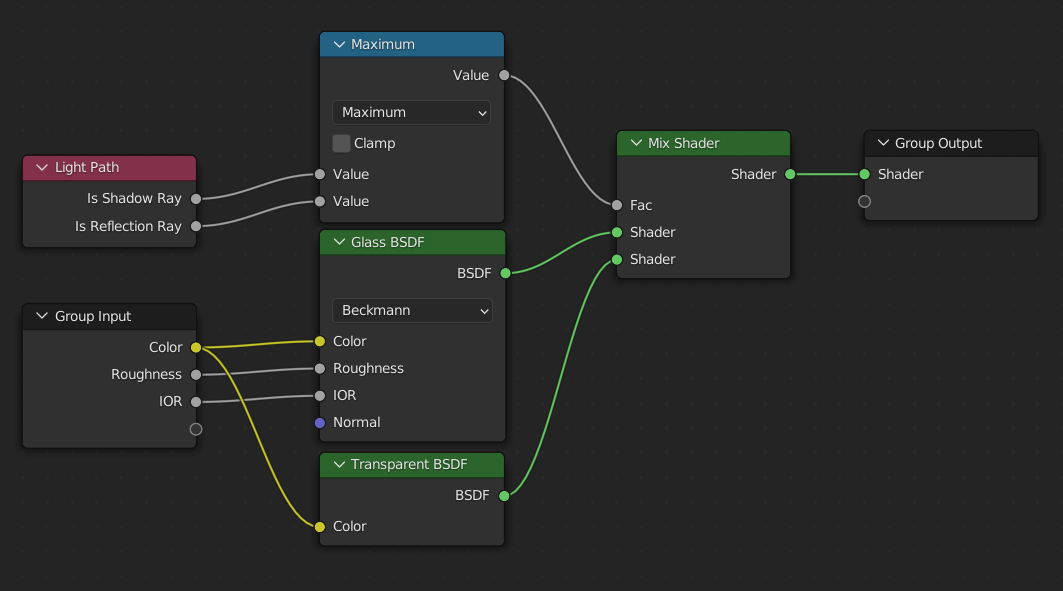
Ví dụ về một nhóm nút mở rộng.
Rã Nhóm (Ungroup)
Tham Chiếu [Reference]
- Trình Đơn [Menu]:
- Tổ Hợp Phím Tắt [Shortcut]:
Ctrl-Alt-G
Xóa nhóm và đặt các cá nhân nút vào không gian làm việc của trình biên soạn của bạn. Việc mất mát các kết nối nội bộ sẽ không xảy ra đâu và bây giờ bạn có thể liên kết các nút nội bộ với các nút khác trong không gian làm việc của mình.
Tách Rời (Separate)
Tham Chiếu [Reference]
- Tổ Hợp Phím Tắt [Shortcut]:
P
The Separate operator removes the selected nodes from a node group and places them in the parent node tree. This is useful when nodes need to be edited outside of a group for clarity or reuse.
- Sao Chép (Copy)
Duplicates the selected nodes into the parent node tree, while keeping the originals inside the group. This is useful when you want to reuse nodes outside of the group but still preserve the group definition.
- Di Chuyển (Move)
Moves the selected nodes to the parent node tree, removing them from the original group. This is useful when simplifying a group or exposing its contents directly.
Join Group Inputs
Tham Chiếu [Reference]
- Trình Đơn [Menu]:
- Tổ Hợp Phím Tắt [Shortcut]:
Ctrl-J
Merges multiple selected Group Input nodes into one consolidated Group Input node when possible. Existing links are preserved, and duplicate inputs are unified to reduce clutter and simplify the node tree.
This operation is useful for cleaning up node groups that have become disorganized or contain redundant input nodes.