Mesh Primitives
参照
- Mode(モード):
Object Mode, Edit Mode
- Menu(メニュー):
- ショートカットキー:
Shift-A
Meshes are the most common object type used in 3D scenes. Blender provides a variety of built-in mesh primitives that serve as starting points for modeling. These primitives can be added in both Object Mode and Edit Mode, where they appear at the location of the 3D Cursor.
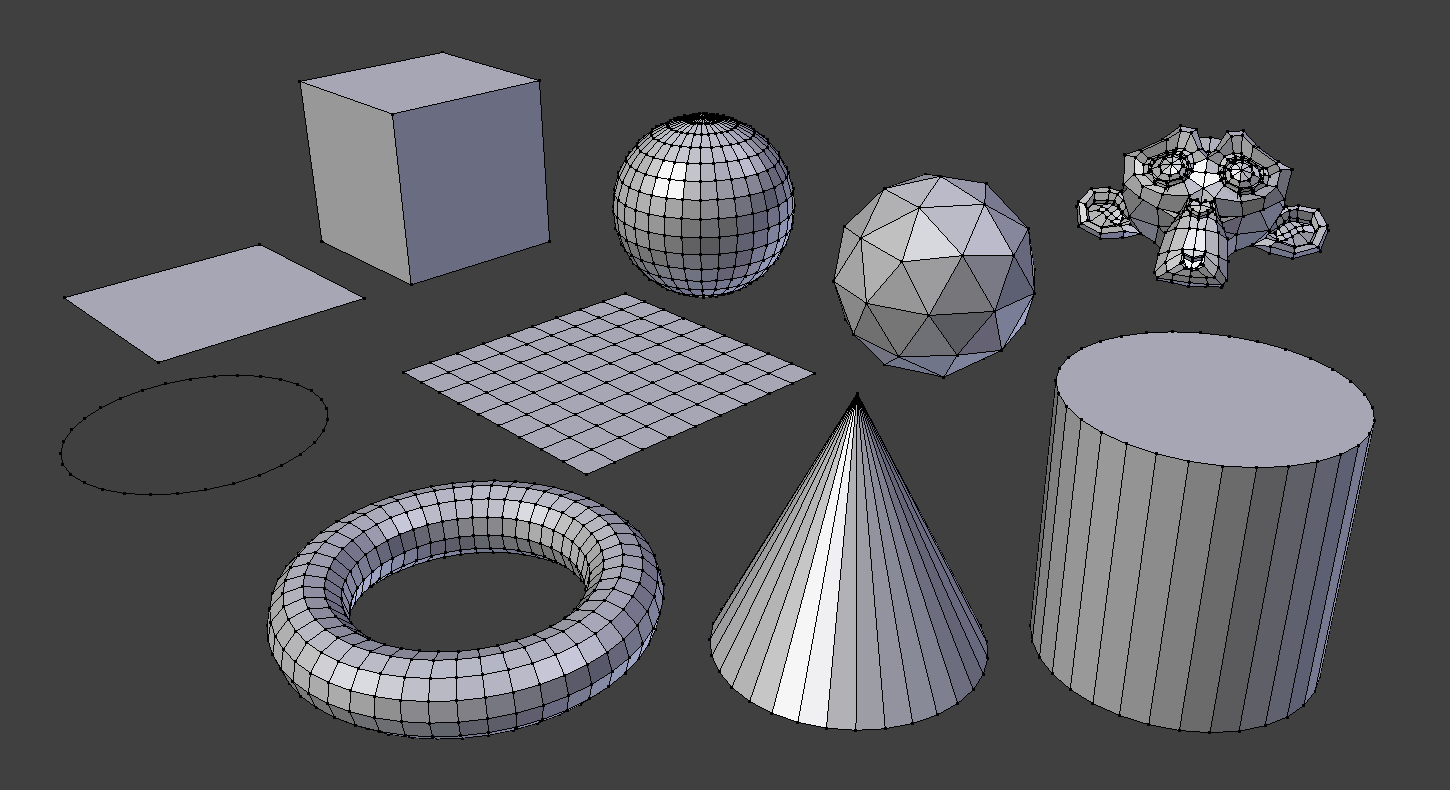
Blender's standard mesh primitives.
Tip
Planar meshes like Plane, Circle, and Grid can become three-dimensional by moving vertices out of their original plane.
注釈
Additional primitives can be enabled through add-on extensions. See Get Extensions for more information.
共通のオプション
これらのオプションは、オブジェクトを作成したときに表示される Adjust Last Operation(最後の操作を調整) パネルで設定できます。複数のプリミティブで設定できるオプションは以下のとおりです:
- Generate UVs(UVを生成)
新しい形状に対して、デフォルトのUV展開を生成します。これは最初のUVレイヤー(必要に応じて追加されます)として作られます。
- Align to View, Location, Rotation
Plane(平面)
The standard plane is a single quad face composed of four vertices, four edges, and one face. It lies flat and has no thickness, making it a purely two-dimensional object.
Planes are commonly used to represent surfaces such as floors, walls, tabletops, or mirrors. They are also frequently used as emitter objects, camera backgrounds, or for projection mapping.
- Size(サイズ)
Sets the width and height of the plane (the full extent from edge to edge).
参考
Mesh Plane allows importing an image as a textured plane. The plane's dimensions are automatically scaled to match the image's aspect ratio.
Tip
Planes are useful as a starting point for modeling panels, ceilings, cloth simulations, or sculpting surfaces. Apply modifiers like Subdivision Surface or Displace to turn a flat plane into complex geometry.
Cube(立方体)
Adds a standard cube mesh composed of six quad faces, eight vertices, and twelve edges. This is one of the most basic and frequently used primitives in modeling, serving as a starting point for creating boxes, crates, buildings, or sculpting bases.
- Size(サイズ)
Sets the total width, height, and depth of the cube (i.e., the full diameter along each axis). A size of 2 creates a cube that spans from -1 to +1 on all axes.
Tip
The cube is ideal for hard-surface modeling and is commonly used as a base for applying modifiers such as Subdivision Surface, Boolean, or Bevel.
Circle(円)
Adds a flat, 2D ring of vertices forming a polygonal approximation of a circle. This primitive is useful as a starting point for cylindrical objects, holes, pipe ends, or extrusion-based modeling workflows.
- Vertices(頂点)
Number of vertices used to define the perimeter of the circle. Higher values result in a smoother shape.
- Fill Type(フィルタイプ)
Sets how the center of the circle is filled:
- Triangle Fan(三角の扇形):
Fills the circle with triangular faces sharing a central vertex.
- N-gon(Nゴン):
Fills the center with a single N-gon face.
- Nothing(なし):
Leaves the circle unfilled; only the perimeter vertices are created.
- Radius(半径)
Distance from the center to the outer edge of the circle.
UV Sphere(UV球)
A UV sphere is composed of quad faces arranged in horizontal rings and vertical segments, with triangle fans at the poles. This structure mirrors how textures are typically mapped in 2D (hence the name "UV" sphere), making it well-suited for texturing.
It resembles lines of latitude and longitude on a globe, which also makes it useful for planetary models or spherical shapes with pole-to-pole UV seams.
- Segments(セグメント)
Number of vertical segments (longitudinal divisions). These are like meridians on a globe, running from the north to south pole.
- Rings(リング)
Number of horizontal segments (latitudinal divisions). These are like parallels on a globe, stacked from top to bottom.
注釈
Rings correspond to face loops, not edge loops, so the actual number of visible edge loops is one less.
- Radius(半径)
Distance from the center to the outer surface of the sphere.
Tip
For clean shading, enable Smooth Shading and apply a Subdivision Surface modifier.
Icosphere(ICO球)
An icosphere is a sphere built from equilateral triangles and has a more uniform distribution of vertices compared to a UV sphere. This makes it ideal for sculpting, simulations, or applications where topological regularity is important.
It is created by recursively subdividing the faces of an icosahedron, which is a polyhedron with 20 triangular faces.
- Subdivisions(細分化)
Number of recursive subdivision steps. Each step splits every triangle into four new triangles, increasing the mesh resolution exponentially.
Subdivision Level 1 creates the base icosahedron.
Higher levels smooth the surface and increase vertex count.
警告
Subdividing an icosphere quickly increases the vertex count. For example, 10 subdivisions generate over 5 million triangles and may crash Blender.
- Radius(半径)
Distance from the center to the outer surface of the sphere.
Tip
Icospheres are often used in simulations, particle emitters, and sculpting workflows where uniformity and triangle-only topology are beneficial.
Cylinder(円柱)
Creates a cylindrical mesh composed of two circular ends and vertical faces. This shape is commonly used to model objects like handles, rods, pillars, and barrels.
- Vertices(頂点)
Number of vertices used to define the circular ends. Higher values result in a smoother circular profile.
- Radius(半径)
Radius of the cylinder's circular ends, measured from the center to the perimeter.
- Depth(深度)
Height of the cylinder along the Z axis.
- Cap Fill Type(ふたのフィルタイプ)
Determines how the top and bottom of the cylinder are filled:
- Nothing(なし):
No end caps are added. Only the side faces are created, forming a tube. Useful for modeling pipes or hollow containers.
- N-gon(Nゴン):
Each end is filled with a single N-gon face.
- Triangle Fan(三角の扇形):
Each end is filled with triangular faces sharing a central vertex.
Cone(円錐)
Creates a cone- or pyramid-shaped mesh. Useful for modeling objects like spikes, traffic cones, or wizard hats. You can also create frustums (truncated cones) or simple pyramids by adjusting the top radius.
- Vertices(頂点)
Number of vertices used to define the circular base (or polygon base in the case of a pyramid). Higher values produce smoother curves.
- Radius 1(半径1)
Radius of the base of the cone (bottom circle).
- Radius 2(半径2)
Radius of the tip (top circle). A value of 0 creates a standard cone with a pointed tip. Non-zero values result in a frustum shape.
- Depth(深度)
Height of the cone along the Z axis.
- Cap Fill Type(ふたのフィルタイプ)
Determines how the base of the cone is filled:
- Nothing(なし):
No bottom cap is added. Only the side faces are created. Useful for creating open containers or hollow cones.
- N-gon(Nゴン):
Fills the base with a single N-gon face.
- Triangle Fan(三角の扇形):
Fills the base with triangular faces sharing a central vertex.
Tip
To create a pyramid, set Vertices to 4 and use N-gon or Triangle Fan as the cap type. Adjust Radius 2 to 0 to keep the top pointed.
Torus(トーラス)
A doughnut-shaped primitive created by rotating a circle around an axis. This shape is commonly used for rings, pipes, and stylized details.
- Operator Presets(オペレータープリセット)
Saved torus settings that can be reused. These are stored as Python scripts in the presets directory.
- Major Segments(大セグメント数)
Number of segments that make up the main circular ring of the torus. Think of this as the number of steps in the spin operation around the central axis.
- Minor Segments(小セグメント数)
Number of segments making up the circular cross-section of the torus. Each segment is rotated around the main ring.
- Dimensions Mode(寸法モード)
Selects the method used to define the shape and size of the torus:
- Major/Minor:
Define the torus using the radius of the main ring and the radius of the cross-sectional circle.
- Exterior/Interior:
Define the torus using the total outer radius and the radius of the central hole.
- Major Radius Major/Minor
Distance from the center of the torus to the center of the cross section.
- Minor Radius Major/Minor
Radius of the cross-sectional circle (thickness of the ring).
- Exterior Radius Exterior/Interior
Total radius from the center of the torus to its outer edge.
- Interior Radius Exterior/Interior
Radius of the hole at the center of the torus.
Grid(グリッド)
A regular grid composed of quadrilateral faces, useful as a base for landscapes, cloth, or organic surfaces. You can increase the number of subdivisions to create a more detailed mesh suitable for sculpting or simulation.
- X Subdivisions(X軸方向の分割数)
Number of face spans along the X axis.
- Y Subdivisions(Y軸方向の分割数)
Number of face spans along the Y axis.
- Size(サイズ)
Sets the width and height of the plane (the full extent from edge to edge).
Monkey(モンキー)
Adds a stylized monkey head mesh named "Suzanne". Suzanne is a gift from old NaN to the community and remains in Blender as a playful "Easter egg" and is widely recognized as Blender's mascot.
This primitive is commonly used for testing materials, lighting setups, and modifiers such as Subdivision Surface.
It serves a similar purpose to well-known test models like the Utah Teapot or the Stanford Bunny.
- Size(サイズ)
Controls the overall scale of the mesh.