Passes
参照
- Panel(パネル):
A Pass is a type of intermediate rendering information that's extracted as a separate image. Examples include the diffuse colors of the objects in the scene, the light distribution, the depth map, and the normal map.
These images can be accessed using the Render Layers(レンダーレイヤー)ノード in the Compositor(コンポジター) and combined in a custom way that replaces the standard one.
Data(データ)
- Include(内容)
- Combined Cycles, EEVEE, Workbench
The render output before any compositing is applied.
- Depth Cycles, EEVEE, Workbench
Distance to the nearest visible surface. Can be used with the Defocus(ピンボケ)ノード for a fake Depth of Field effect.
注釈
This pass produces noisy results if the render itself uses Depth of Field or motion blur. Use the Mist pass for a cleaner image.
- Mist Cycles, EEVEE
Distance to the nearest visible surface, mapped to the 0.0 - 1.0 range. When enabled, settings become available in the World tab.
This pass can be used to fade out objects that are farther away. An alternative is using the Volume slot of the World Output shading node.
- Position Cycles, EEVEE
Positions in world space.
- Normal Cycles, EEVEE
Surface normals in world space.
- Vector Cycles, EEVEE
Motion vectors for the Vector Blur Node. The four components consist of 2D vectors giving the screen-space motion based on the next and previous frames.
This pass is disabled when Motion Blur is enabled.
- UV Cycles
The UV coordinates within each object's active UV map, represented through the red and green channels of the image. (The blue channel stores a constant value of 1 and does not hold any information.) Can be used with the Map UV(UVマッピング)ノード.
- Grease Pencil Cycles, EEVEE, Workbench
Outputs only the visible (non-occluded) strokes and fills from the Grease Pencil engine into a separate image layer.
This pass is useful for compositing workflows where you want to isolate, enhance, or apply effects to Grease Pencil elements separately from the rest of the render.
注釈
For most scenes, blending this pass over the rest of the image using an Alpha Over node will reproduce the Combined render result. However, some blending modes in Grease Pencil can modify the chromaticity of the alpha channel. In these cases, compositing the Grease Pencil pass separately can produce different results.
- Denoising Data Cycles
Includes auxiliary passes used for denoising, along with the combined image before denoising. These passes can be used with the Denoise(デノイズ)ノード as an alternative to automatic denoising.
Noisy Image -- The combined render result before any denoising is applied.
Denoising Albedo -- The diffuse base color of surfaces without lighting or shading.
Denoising Specular Albedo -- The specular base color, representing reflective surface color without lighting.
Denoising Normal -- Surface normals used to preserve edges and fine detail during denoising.
Denoising Roughness -- Surface roughness values used to improve denoising of glossy reflections.
Denoising Depth -- Distance from the camera, used to help preserve depth-based detail.
These passes provide additional information to the denoiser, resulting in higher-quality output compared to using the noisy image alone.
注釈
These passes increase memory usage and render time. Enable them only when denoising in the Compositor is required.
- Indexes
- Object Index Cycles
A map where each pixel stores the user-defined ID of the object at that pixel. This map can be converted into a mask for a particular object using the ID Mask(IDマスク)ノード.
- Material Index Cycles
A map where each pixel stores the user-defined ID of the material at that pixel. This map can be converted into a mask for a particular material using the ID Mask Node.
注釈
The Depth, Position, Object Index, and Material Index passes are not anti-aliased.
- Debug
- Render Time Cycles
An estimate for how long in milliseconds each pixel took to render. Note, this pass is not supported on GPU rendering.
- Sample Count Cycles
Number of samples calculated for each pixel, divided by the maximum number of samples. Used to analyze adaptive sampling.
- Alpha Threshold Cycles
The Depth, Position, Normal, Vector, UV, and Index passes are only affected by surfaces with an opacity equal to or higher than this threshold. With value 0.0, the first surface hit will always write to these passes regardless of opacity. With higher values, surfaces that are mostly transparent will be skipped until an opaque surface is encountered.
Light(ライト)
Cycles
- Diffuse(ディフューズ)
- Direct
The intensity and color of light that hit a surface with a Diffuse or Subsurface Scattering BSDF and did not yet bounce off/pass through any other surface (ignoring Transparent ones). The color of the surface itself is not included.
- Indirect
The intensity and color of light that hit a surface with a Diffuse or Subsurface Scattering BSDF and already bounced off/passed through another surface before (ignoring Transparent ones). The color of the surface itself is not included.
- Glossy (光沢)
- Direct, Indirect, Color
Same as above, but for glossy BSDFs.
- Transmission
- Direct, Indirect, Color
Same as above, but for transmissive BSDFs.
The Transparent BSDF is not included; see Light Paths for details. To create a transparent surface that does get included in this pass, use a Glass (グラス) BSDF with the IOR set to 1.
- Volume(ボリューム)
- Direct, Indirect
Same as above, but for volumetric BSDFs.
- その他
- Emission(放射)
Emission from directly visible surfaces.
- Environment
Emission from the directly visible World Environment. When the Film(フィルム) is set to Transparent (meaning the world is excluded from the final render), this pass can be used to get the environment color and composite it back in.
- Ambient Occlusion(アンビエントオクルージョン(AO))
Ambient occlusion from directly visible surfaces. This is a grayscale pass with values that go from 0 (fully occluded) to 1 (fully exposed), making it suitable for multiplying with a color image in the Compositor (see Mix Color Node).
As an alternative to this pass, it's also possible to use the Ambient Occlusion Node in materials.
- Shadow Catcher
Shadows collected by objects with the Mask -- Shadow Catcher option enabled. Can be multiplied with existing footage to (for example) have a rendered object cast a shadow on recorded ground.
EEVEE
- Diffuse(ディフューズ)
- Light(ライト)
The intensity and color of light that hit a surface with a Diffuse or Subsurface Scattering BSDF. The color of the surface itself is not included.
- Color(カラー)
The colors of Diffuse and Subsurface Scattering BSDFs, modified by any Mix and Add Shader nodes. The intensity and color of light are not included.
- Specular(スペキュラー)
- Light, Color
Same as above, but for specular BSDFs.
- Volume(ボリューム)
- Light(ライト)
Contains Volume objects, as well as any volumes generated by the volume shader nodes (Principled Volume(プリンシプルボリューム), Volume Absorption(ボリュームの吸収), and Volume Scatter(ボリュームの散乱)), whether they're used in a material or in the World background.
- その他
- Emission(放射)
Emission from directly visible surfaces.
- Environment
Emission from the directly visible World Environment. When the Film(フィルム) is set to Transparent (meaning the world is excluded from the final render), this pass can be used to get the environment color and composite it back in.
- Shadow(影)
A pass that's black for areas that don't receive direct light and white for ones that do. Mostly useful for compositing objects with shadow into existing footage.
- Ambient Occlusion(アンビエントオクルージョン(AO))
Ambient occlusion from directly visible surfaces. This is a grayscale pass with values that go from 0 (fully occluded) to 1 (fully exposed), making it suitable for multiplying with a color image in the Compositor (see Mix Color Node).
As an alternative to this pass, it's also possible to use the Ambient Occlusion Node in materials.
- Transparent(透過)
Contains Blended surfaces, so they can be adjusted in the Compositor and later mixed with opaque passes.
This pass only supports grayscale opacity. Colored opacity will show differently than in the Combined pass.
- Occlusion Distance
Maximum distance for objects to contribute to the Ambient Occlusion pass.
Cryptomatte
Cryptomatte is an image standard to efficiently create masks for specific objects or materials. Its purpose is the same as the Object Index and Material Index passes, but it has several advantages: it's easier to set up, can be used with other compositing software than Blender, and supports multiple objects per pixel. Specifically, it works with transparency, as well as motion blur and depth of field when using Cycles.
- Object(オブジェクト)
Render cryptomatte passes for isolating objects.
- Material(マテリアル)
Render cryptomatte passes for isolating materials.
- Asset(アセット)
Render cryptomatte passes for isolating groups of objects with the same parent. This option is not related to Blender's asset feature.
- Levels
The maximum number of objects to be distinguished per pixel. The Render Layers node will output half this many Cryptomatte images, named (for example) CryptoObject00, CryptoObject01 and so on -- the reason being that one Cryptomatte image can reference two objects per pixel.
The first image references, for each pixel, the two objects that contribute the most to that pixel's color. The next image references the next two objects, and so on.
Shader AOV
Shader AOVs (Arbitrary Output Variables) are custom render passes that can hold additional information for use in compositing. Create a pass in the Shader AOV panel, write to it from a material using the AOV Output Node, and finally read from it in the Compositor using the socket on the Render Layers node.
- Name(名前)
The name of the render pass. Used in both the AOV Output node and the Render Layers node. The name can be anything as long as it doesn't conflict with other (enabled) passes.
- Data Type(データタイプ)
The type of data that the render pass stores per pixel. Use Color to store a color, normal, or other type of vector. Use Value to store a single number.
Light Groups
Cycles only
A Light Group provides a limited Combined render pass where the scene is only illuminated by certain lights. Multiple such passes can then be combined in compositing to construct a full render with all the lights. The most straightforward way is to simply Add them together using the Mix Color Node, but by making more complex combinations, it's possible to change the color and intensity of individual lights without having to re-render.
To assign a Light object to a new or existing Light Group, use the panel (details).
To assign the World background to a Light Group, use the panel (details).
- Name(名前)
The name of the light group.
Light Group Sync
These operators are available from the button to the right of the Light Group list.
- Add Used Lightgroups
Create Light Groups for any lights that reference a non-existing one.
- Remove Unused Lightgroups
Delete any Light Groups that are not referenced by any lights.
Combining
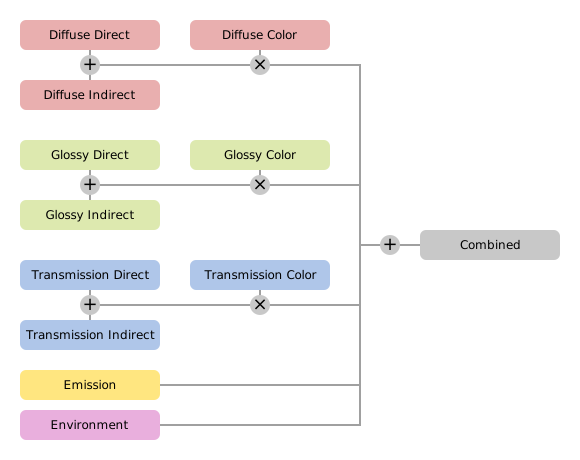
Cycles
The different render passes can be combined to produce the final image as follows:
EEVEE
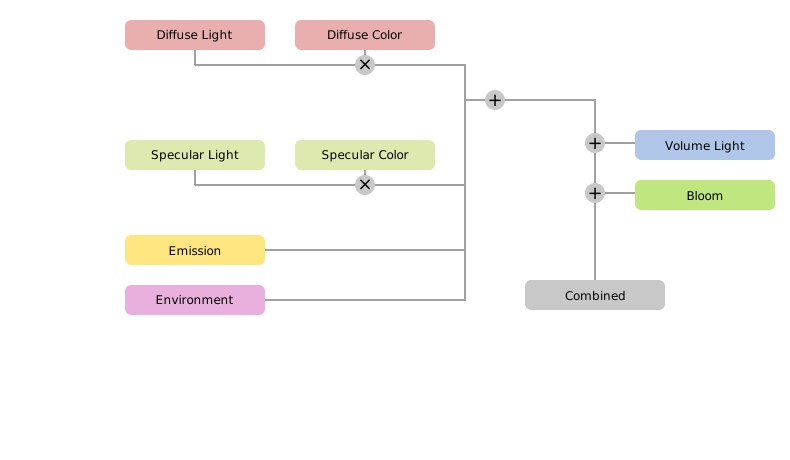
The passes can be combined to produce the final image as follows:
EEVEE Limitations
Depth of Field(被写界深度) and Motion Blur(モーションブラー) are not rendered in passes other than Combined. They can be emulated in the Compositor using the Defocus(ピンボケ)ノード and the Vector Blur Node.
Transparent materials that have their Render Method set to Blended are not rendered in passes other than Combined and Transparent. Use the Dithered method instead.
The Shader To RGB Node only works correctly in the Combined pass as EEVEE excludes parts of the BSDF equation.
There is a maximum of 16 Color and 16 Value AOVs (custom render passes).