Restricción Esqueleto
The Armature constraint transforms an «owner» object or bone based on the weighted pose transformations of one or more «target» bones. It’s similar to the Modificador Esqueleto, which performs this operation for every vertex in a mesh.
Unlike the modifier, the constraint also uses bones whose Deform option is disabled.
Ver también
The Restricción Subordinar is an alternative if there’s only one parent. Unlike with the Armature constraint, this parent can also be an object.
Opciones
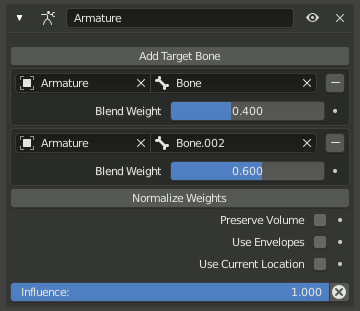
La restricción Esqueleto.
- Preservar volumen
Prevents the owner from shrinking when the target bones rotate relative to each other.
- Usar envolventes
Uses Envelopes to weaken the influence of target bones that are further away. For best results, set the Weight of all bones to 1.0.
Nota
Unlike the modifier, the constraint does not automatically detect nearby bones. Every bone has to be added manually.
- Use Current Location Bone constraint only
By default, the constraint uses the rest location of the owner bone to find nearby envelopes and B-Bone segments. This option uses the bone’s current location instead (so including the pose transformation and prior constraints).
Objects don’t have a rest location, so for them, the constraint always uses the current location.
- Agregar hueso objetivo
Adds a new entry to the Bones list.
- Normalizar influencias
Normalizes the Weights in the Bones list so they add up to 1.0.
- Influencia
How strongly the constraint affects the owner.
Huesos
The list of target bones used to transform the owner.
- Objetivo
The armature object containing the bone. Unlike the modifier, the constraint can use bones from different armatures.
- Sub-Target
The name of the bone.
- (Eliminar objetivo)
Removes the entry from the list.
- Influencia
Weight associated with the bone. With the modifier, this weight would come from a vertex group instead.