Vistas contextuales
By default, the 3D Viewport displays the scene from a single viewpoint. Using Quad View allows viewing the scene from multiple perspectives at the same time, providing additional spatial context while modeling, sculpting, or editing.
Vista cuádruple
Referencia
- Modo:
Todos los modos
- Menú:
- Atajo:
Ctrl-Alt-Q
Toggling Quad View splits the 3D Viewport into four regions: three orthographic views (Top, Front, and Right by default) and one perspective (User) view.
This layout makes it easier to understand the spatial relationships between objects and to make precise adjustments along specific axes.
The size of each view can be adjusted by clicking and dragging from the center point where the four regions meet.
Nota
Quad View is different from splitting the area and aligning views manually. In Quad View, all four regions are part of the same 3D Viewport and therefore share display settings such as shading mode, overlays, and visibility options.
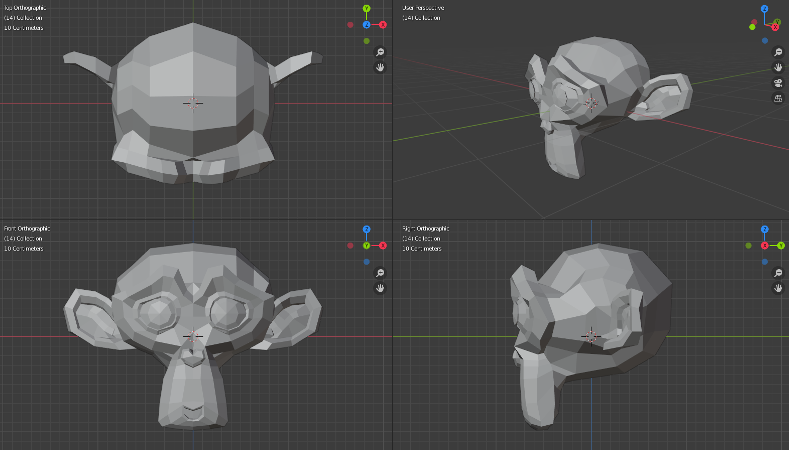
La vista cuádruple.
Opciones
Referencia
- Modo:
Todos los modos
- Menú:
- Bloquear rotación
Prevents changes to the orientation and perspective of the orthographic side views. When enabled, navigation in one view will not rotate or switch the others. Note, enabling this option resets the three views to their default orientations (Top, Front, and Right).
- Sincronizar ampliación/desplazamiento
Synchronizes zooming and panning between the orthographic side views. This option requires Lock Rotation to be enabled.
- Recortar contenido
Clips objects to the visible region defined by the orthographic views. Geometry outside the combined viewing volume is hidden, making it easier to inspect interior details or work on dense scenes.